Not all mixing needs a tank and agitator. When two liquids must blend evenly while flowing — such as chemicals dosed into water, or two components joined before a machine — a static mixer is a simple, economical answer.
How it works
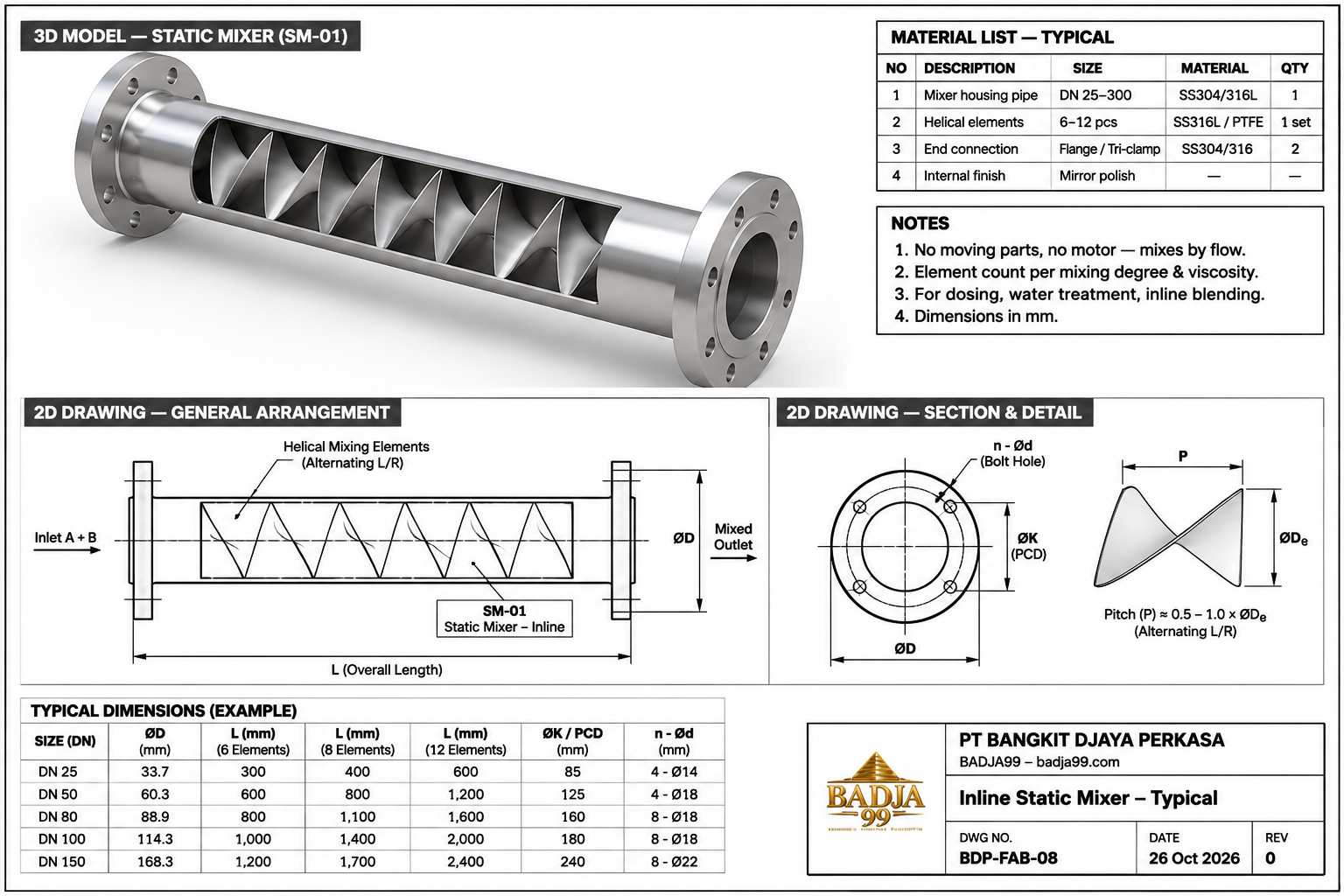
A static mixer is a section of pipe containing spiral (helical) elements installed with alternating twist. As liquid flows, the elements keep splitting, rotating and recombining the stream, so liquids blend evenly over a short distance. No motor and no moving parts — the energy comes from the flow itself.
Benefits
- No electricity and almost no maintenance.
- Consistent mixing as long as flow is steady.
- Compact, installed directly in existing lines.
Applications
- Acid/alkali and coagulant dosing in water treatment.
- Liquid blending in food, beverage and chemical plants.
- Inline dilution and pH adjustment.
Specification
SS304/SS316L body with polished interior, SS316L or PTFE elements, flanged or tri-clamp ends. Element count and diameter are set from flow rate, viscosity and required mixing degree.
Technical drawing
The drawing below shows an example inline static mixer with a cutaway revealing the helical elements.