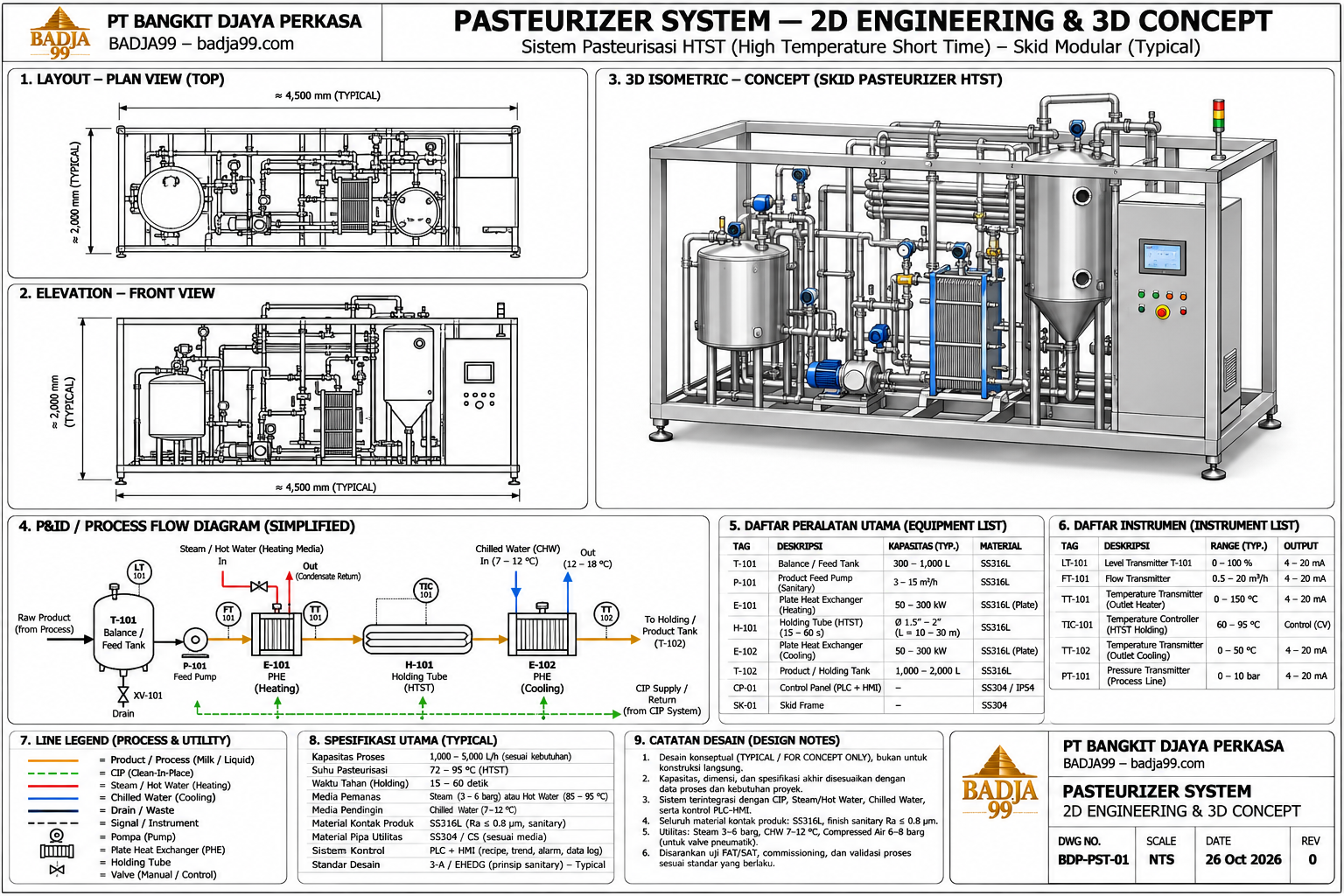
Pasteurizer Systems for Process Industries
Pasteurization is a heat treatment process that uses specified temperatures and holding times to reduce microorganisms that may affect product safety and help preserve product quality. The process is widely used in dairy, beverage, and other liquid food industries.
Pasteurizer system design must consider product characteristics, production capacity, heating requirements, and operating conditions to ensure the system suits the intended manufacturing process.
Types of Pasteurizer Systems
The configuration is selected according to product characteristics and production requirements. Common system types include:
Batch Pasteurizer: heats products in a tank according to a defined process sequence and specified parameters.
Continuous Pasteurizer: heats products flowing continuously through the processing system.
Plate Heat Exchanger System: uses a plate-type heat exchanger for heat transfer in applications suited to the equipment.
Tubular Pasteurizer: uses a tubular heat exchanger for products and process conditions suited to this configuration.
System selection considers product characteristics, production capacity, heat transfer requirements, and process specifications.
System Design and Components
The design scope may include heating method selection, equipment capacity, product routing, and utility requirements. Depending on the project configuration, the system may include tanks, product pumps, heat exchangers, temperature sensors, valves, and other supporting equipment.
Temperature and holding time parameters are determined according to product characteristics and applicable pasteurization requirements. A control system can monitor operating conditions and regulate process parameters as required.
Connection to Production Lines
The pasteurizer is designed with consideration for upstream and downstream equipment, including process tanks, piping, and filling machines where included in the project scope.
The design also considers equipment cleaning, maintenance access, and compatibility with the production facility layout. A CIP system can be provided as a separate service according to project requirements.
Testing and Operational Readiness
Before operation, the system should be inspected and tested in accordance with project specifications. Checks may include equipment functions, sensor readings, temperature regulation, and control system performance where applicable.
Process parameters are configured and verified according to technical requirements and product needs to support consistent operation.