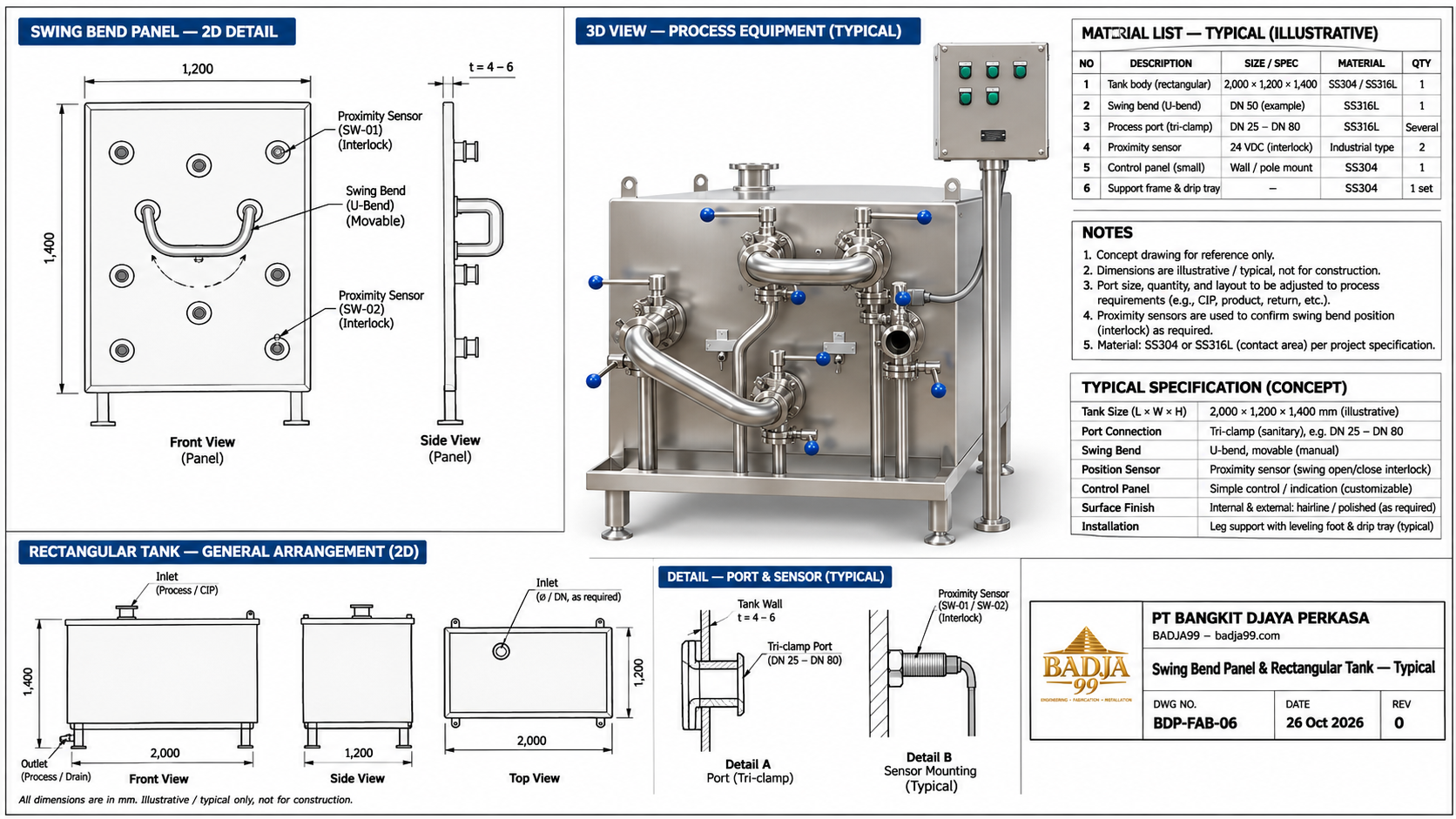
In plants with many tanks and lines, flow often needs to be switched: from tank A to machine B today, then to machine C tomorrow, or product lines connected to CIP during cleaning. A swing bend panel makes these changes clear, safe and hygienic.
How a swing bend panel works
The panel is a stainless plate with neatly arranged ports (pipe ends). Operators connect two ports with a U-shaped pipe (swing bend). Because only one connection can be made at a time, the risk of product mixing with CIP solution is very low. Ports can carry proximity sensors so the control system knows which connection is in place (interlock).
Rectangular tanks
Not every site suits a cylindrical tank. Rectangular tanks use space more efficiently — for water, solutions, temporary holding or under-machine tanks. Walls are stiffened so they don't bulge when full.
Technical drawing
The drawing below shows an example swing bend panel with ports and a U-bend, and a rectangular tank with inlet and outlet nozzles.