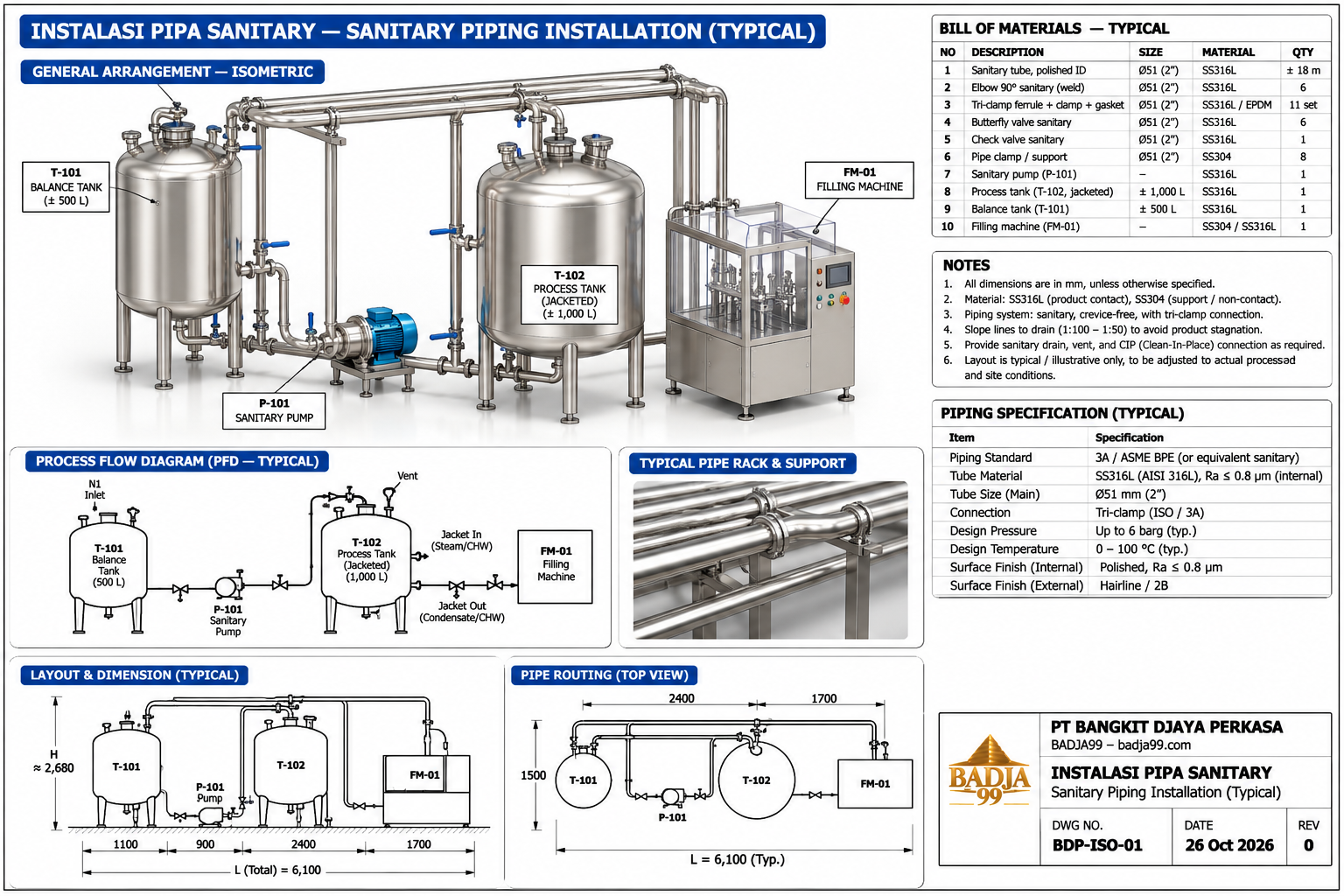
Sanitary Piping for Process Industries
In food, beverage, dairy, and pharmaceutical facilities, piping systems must be installed with consideration for product hygiene and production requirements. Material selection, joint quality, welding finish, and piping layout all affect system cleanability and maintenance.
Pipe Materials
Sanitary piping commonly uses SS304 or SS316 stainless steel. Material selection depends on the product, operating temperature, cleaning agents, and the plant owner's technical requirements.
SS304 is used in many food and beverage applications, while SS316 may be selected where greater corrosion resistance is required. Final material selection follows the project's specifications and operating conditions.
Installation Details
Installation work considers joining methods, weld quality, piping layout, and access for inspection and maintenance. Welding methods are selected according to the material, design, and project requirements. Orbital welding or internal boroscope inspection may be applied when included in the project scope.
Piping layout also considers drainage, areas where liquid may remain trapped, and ease of cleaning. For systems using CIP (Cleaning-in-Place), the piping arrangement follows the cleaning process requirements and system specifications.
From Process Lines to Filling Machines
The scope may include piping from receiving tanks, process and mixing tanks, pumps, and heat exchangers through to filling machines. Work may also cover connections to existing equipment and CIP lines, depending on the project scope.
For operating facilities, installation activities can be coordinated with the plant team to manage work access and minimize disruption to production.
Inspection and Documentation
After installation, piping and joints are inspected in accordance with project procedures. Leak testing, flushing, and additional checks are performed according to technical requirements before the system is put into service.
Project documentation may include material records, weld location records, and inspection results, as required.
Installation Based on Project Requirements
Each facility has different equipment layouts, production needs, and hygiene requirements. Sanitary piping work is therefore tailored to the plant layout, technical specifications, and operational requirements.